HubSpot Data Hygiene
 Carel Schrier
Improve your business results with data hygiene in your CRM
Imagine you are in the flow, looking for customer data in your CRM, and then you discover that certain customer profiles are simply wrong. You see incorrect email addresses, no linked companies, contacts that hard bounce, or other data that is incomplete. At that point your CRM is no longer adding value, it is actively working against you. We understand better than anyone that keeping your data consistent, up to date and clean is a huge challenge. Fortunately, HubSpot lets you get a grip on your data hygiene. How? We explain that in this blog.
What is data hygiene?

Data hygiene is an essential aspect of managing a CRM system such as HubSpot. It refers to the processes that keep your data accurate, complete and reliable. That means you need to consistently update records, remove duplicates, verify the accuracy of your data, and properly manage unsubscribes and bounce rates. Good data hygiene improves segmentation, targeting and personalisation, which results in better engagement and conversion rates among your (potential) customers. On top of that, a well maintained database is the foundation for efficient operations and strategic marketing decisions.
What does data hygiene get me?
If you apply data hygiene properly, it delivers the following.
1. You understand your customer better
The effectiveness of your marketing efforts largely depends on understanding your customers' needs and pain points and responding to them. Incomplete or incorrect data can lead to the wrong decisions. Marketing emails, sales conversations and other interactions all benefit immediately from a clean, reliable dataset. You improve the way you engage with prospects, customers and advocates.
2. Improved segmentation and personalisation
When your data is accurate and consistent, you can start segmenting and personalising. You can address your target audience correctly, without errors creeping in. Research from HubSpot shows that good segmentation within email marketing delivers a higher open rate and click through rate. So if you segment using incorrect data, that can actually push those numbers down.
3. Better relationships with your customers
As mentioned, accurate data means you can segment better and are less prone to errors. When you interact with customers based on incorrect data, that can lead to inconsistent communication and poor experiences for your customers. Research from Medium shows that 91% of customers would rather buy from companies that value, recognise and offer relevant deals to their customers. This helps you build a lasting customer relationship.
4. Reduce duplicate data
Duplicate data can make reports inaccurate, which skews your numbers. That makes it harder to build forecasts and estimates. Duplicate data is a major pain point for many companies. It is often caused by migrations, incorrect imports or manually created records. In many cases, as much as 45% of records turn out to be duplicates, which can have a significant effect on efficiency.
5. Reduce wasted budget
If your CRM is in poor shape, that can eventually lead to financial losses. Research shows that it costs organisations an average of 12.9 million. Think of campaigns sent to email addresses that no longer exist. This affects your bounce rate, which can damage your email domain. On top of that, you might send customers incorrect or duplicate messages, which affects how customers perceive you. Addressing the quality of your data is therefore an important factor when it comes to your company's spending.
6. Better alignment between marketing, sales and service
At many companies, alignment between marketing, sales and service remains a challenge. Departments do not collaborate well, so you end up with separate silos that each do their own thing with the best intentions. As a result, certain departments may be missing crucial information they need to act on. It is therefore important to create a unified customer view, so you have the right context to respond appropriately at the individual customer level within marketing, sales or service.
7. Improve the decision making process
It might sound obvious, but better data means better decisions. When you work with accurate, cleaned up data, you can make the right decision with confidence. When you work with unreliable data, you will be less inclined to base decisions on data at all. So make sure your data is cleaned up before you take the next step within your company.
8. Increase your productivity
When your employees work in a CRM where they have to deal with incorrect data, it is no surprise that they need to spend more time getting to a good end result. Adding, editing and correcting data to improve accuracy can quietly eat up a huge amount of time. In some cases, time even has to be spent responding to unhappy prospects who received incorrect information. Add in the time spent searching through duplicates and your employees' productivity drops significantly. It is therefore important to have a complete, accurate and cleaned up dataset of your prospects and customers in order to increase productivity.
Best practices for data hygiene
Identifying the problem is one thing, but how do we solve it? Here are a few examples of how you can improve your data within your CRM system.
1. Regular clean ups
Gather up all the clutter and start with one big initial clean up. After that, a regular clean up will be faster and easier to carry out. A regular clean up can involve several things. First, managing duplicates within HubSpot. HubSpot itself will suggest duplicates based on name and/or email, after which you have the option to merge them. Another important factor is making sure the core fields on your record are filled in, such as email, phone number and name. Of course, which additional information is essential can vary by company. Make sure new records cannot be created without the required information. So set mandatory fields on the creation form. Once your data is in your CRM, it keeps moving. At least, as long as your prospects or customers keep engaging with your brand. Is that not the case? Then consider deleting records that have shown no activity for a long time. In many cases these steps can be automated with workflows, so there is continuity too.
2. Data validation
Within HubSpot you have the option to create properties and set a validation rule. straight away. Think of a minimum number of characters, a maximum number of characters, requiring numeric input only, or disallowing special characters. Depending on the property, it is of course also possible to allow only unique values or, for example, to use a date picker that only allows a future date. In short, there is a lot you can do with data validation. Just make sure you keep checking these validations on a regular basis.
3. Consistency
Consistency is key, which is why it is hugely important to use good naming conventions for data fields. Think of naming for job titles, dates or other fields that can vary widely. You can largely solve this by using predefined values, for example in the form of dropdowns. That way you reduce the chance of errors, giving you consistency within that data field straight away. It is also important to agree on guidelines together and put them on paper. That way there is a clear picture of what your data within your CRM should look like. This obviously applies not only to input fields, but also to forms, workflows, images and other elements.
4. Regular updates
Besides regular clean ups, it is also important to carry out regular updates. This might sound a bit like an overlap with point 1, but here you want to make sure you keep enriching your data. Make sure you encourage customer feedback and give customers the option to update their own information. Another option is to automatically push updates based on the interactions your customers have with your company. As a company you naturally also have to deal with your entire tech stack, and HubSpot will not be the only software you use. So make sure you integrate these software packages with each other to push updates back and forth.
5. GDPR
An important factor in the world of data is of course the General Data Protection Regulation (GDPR). The GDPR has given companies that collect and use personal data more responsibilities. Your prospects and customers have therefore also gained more rights, so you need to stay within the lines to avoid a fine. Make sure you have this in order within your company, for example by setting up a team for it or appointing someone as Privacy Officer. That way, responsibility for amending or managing sensitive data sits with specific people. You also make agreements around retention periods, compliance with privacy rules and sharing data with third parties. This person or department is therefore also responsible for regularly monitoring, auditing and assessing your data quality and GDPR compliance.
6. Clean up processes
If you have a lot of useless, duplicate or outdated data, it is important to build a strategy to identify it. Are there contacts within your CRM who have shown no interaction for a long time? Then it is probably wise to remove them. There should be clear rules and criteria in place so you can also build these clean up processes into a workflow. Here it may also be worth setting up an approval process so data is not deleted without oversight. That can otherwise have the opposite effect on your CRM.
7. Monitor data quality
As mentioned, quality data is essential across multiple areas of your company. HubSpot has got your back! They have a dedicated Data Quality Software that lets you keep your data clean, clear and under control. It starts with a solid data structure. With the Data Quality software you can easily map out your data structure and get a grip on your data. With the tool you can keep monitoring the health of your data. This brings bottlenecks to light so you can take action when that health is at risk.
8. Internal training
Once you have put structure in place, it is time to bring your whole organisation along. It is important to bring everyone up to speed on how to use data, how to add to it and how to update it. That way you make sure your data stays clean and that all the effort put into the previous steps was not wasted. So make use of training sessions, videos or other resources to inform your employees. That way you can properly explain the value of data hygiene, so the whole organisation understands why it matters.
Getting a grip on your data hygiene with a dashboard in HubSpot
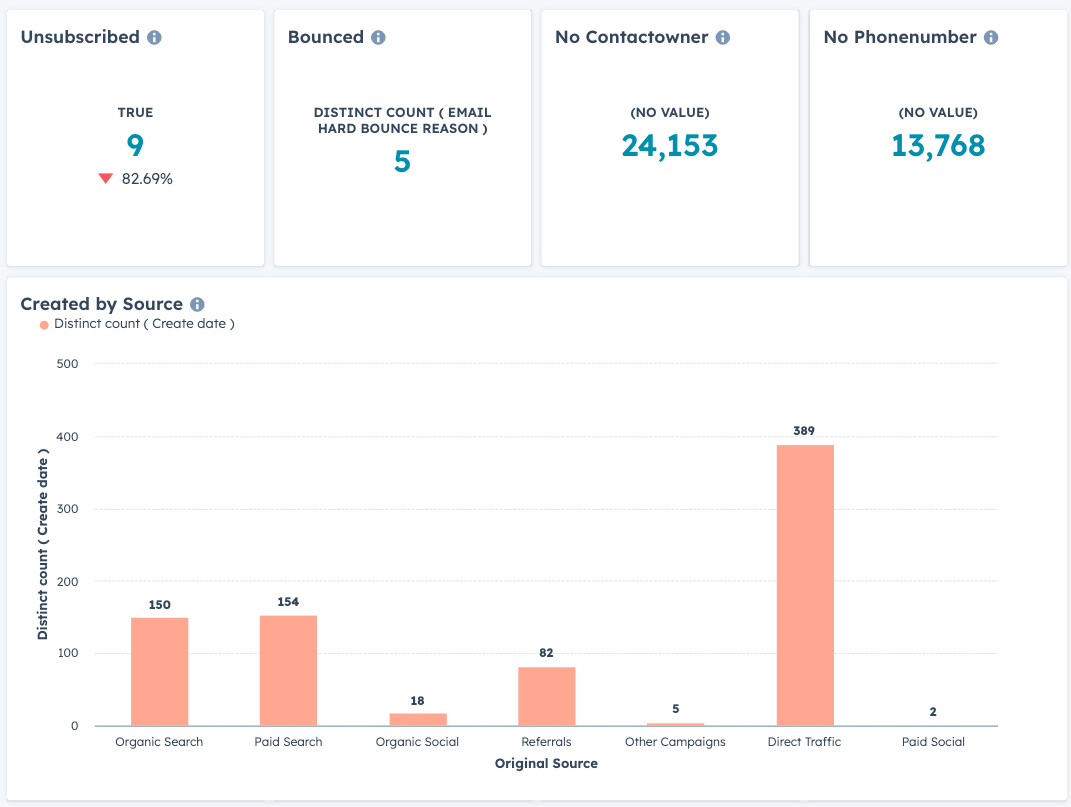
Of course, the Data Quality software is one way to gain control, but you can get even more of a grip by building a dashboard within HubSpot. It is a valuable tool that gives you insight into the health of your data. Essential reports within this dashboard include the following.
Unsubscribes:
Track the number of people unsubscribing from marketing emails.
Email bounces:
Track the number of contacts whose marketing emails are not being delivered. It gives insight into email addresses that no longer work and where your marketing efforts have no effect. This is where you might ask yourself whether these contacts should be removed. In most cases this is a source of impure data.
No contact owner:
Make sure every contact is assigned to a team member for accountability. There is a chance that certain contacts keep floating around in your CRM without any active outreach, and you obviously do not want that.
No subscription type:
No opt-in has been given for any of your email subscriptions. If you look at this per lifecycle stage, you can gain insight into which stage something is not set up correctly.
Data completeness:
Check for missing data in essential fields such as contact names, emails, job titles and associated companies. This helps make sure your data is clean and complete.
Contact creation:
Analyse contact creation in various ways to get a clear picture of how your marketing contacts are being counted. For example, analyse contact creation by source or country.
Of course, there are plenty of other ways to stay on top of your data within this dashboard, such as missing information that matters within your CRM or specific subscription types you want to focus on.
Want to get a grip on your data?
All in all, it is clear that accurate data is essential for your company, and that there are plenty of steps you can take to get there. Not sure where to start? Or do you need an audit? Feel free to get in touch and you will have your data fully under control again in no time.