Data Quality Automation: what is it and how do you use it?
 Carel Schrier
In 2018, a benchmark report found that 95% of executives believe data is an integral part of their business strategy. There is no doubt that data is an important asset for every company. The question is more whether all data is equally valuable. The short answer is no.
While collecting data may be half the work, the real challenge is maintaining high data quality standards throughout the entire lifecycle.
To make things even more difficult, around 50% of companies seem to disagree on who is responsible for managing data. The task is usually spread across operational teams, decision makers and professionals from various departments who manage the data on a daily basis.
But you do need to know how to measure and safeguard data quality. You also need to understand the tools available to support you with this task.

What is Data Quality?
Data quality measures the extent to which data serves its intended purpose. In most cases, the purpose of collecting data is to have information in order to ultimately make decisions. So when we talk about quality data, we mean the type of data that results in high quality information that ultimately leads to data driven decisions. Let’s first take a step back. How does data quality lead to good business decisions?
1. You have data, but it is not yet usable.
At this point you only have values in a database or an Excel file. This raw data has no practical use. For example, you have thousands of email addresses of your customers and possibly their areas of interest in a CSV file.
2. You turn data into information.
You bring that data into a tool where you can visualise it clearly in the right context. For example, an email list within your marketing application. You can then filter the email addresses based on their interests.
3. You gain knowledge.
You can analyse the information gathered to extract insights from it. For example, you might discover that many of your customers actually want to receive information about specific topics.
4. Data driven decisions.
With this knowledge you can make data driven decisions, such as creating a newsletter tailored to what came out of your analysis.
When your data is of poor quality, you have the wrong information and lack the knowledge to make good decisions.
Characteristics of data quality
Since data comes in all shapes and sizes, determining its quality is not always simple. There are some characteristics that are typically attributed to high quality data. If you look for these characteristics in your own data, you will get an idea of your data quality.
1. AccuracyIs your data correct? Does it reflect the actual situation you are looking at? To guarantee accuracy and precision, you need to optimise your data management strategy. The accuracy of your data is linked to data integrity. In general, the best way to minimise errors in your data is to avoid manual data entry as much as possible.
2. CompletenessIs your data complete? Incomplete information can be unusable. While it is not advisable to collect more than necessary, you do need to ensure you have the values that are required to store in your database. Otherwise you end up with names without a surname or incomplete phone numbers that you cannot use.
3. RelevanceIs this the data you need? Not all the data you collect will have a huge impact. When there is a reason why you collect data and the values can contribute to that reason, you have good data quality. For example, if you ask your customers for a date of birth, but their age turns out not to be useful information for you, then it is data without a purpose. The data may well be correct, but it is not effective.
4. ConsistencyDoes your data contradict other sources? High quality data should not contradict the data stored in other databases. Otherwise you would have to assume that one of them is wrong, but which one? When there are inconsistencies between different databases, it becomes a hassle to determine accuracy. There are integration solutions available that let you choose which piece of software ‘wins’ in the event of a conflict.
5. AccessibilityIs the information accessible to the right people? Most companies communicate with customers, prospects, partners and employees through various applications. As a result, data is spread across different tools, and if there is no software integration, you have a problem with data silos.
Data silos are among the main causes of poor data quality. Even with accurate, consistent and relevant data. If the team that should be using this information does not have access to it, it does not serve its purpose. To guarantee accessibility, you need to integrate your systems.
6. TimelinessIs your data up to date? Data changes constantly, and the problem with outdated data is that it may no longer represent the current situation. Keeping historical data is of course useful, but with a clear sense of time. For real time reporting, you need to make sure your data is continuously updated.
How to guarantee high quality data
Taking care of your data quality is not a one off task. It is part of a continuous process in which people, technology and strategy need to be aligned.
As your company grows, the challenges around data management become increasingly complex. That is why a solid foundation, aimed at preventing future problems, is key to safeguarding data quality.
Here are some things to keep in mind from the very first moment you implement a data management strategy:
Data policy: This refers to the company policy and rules that determine the standards when it comes to data management. This policy must be known and applied by everyone who manages data. This will be the starting point for obtaining high quality data.
Data profiling: This has to do with those responsible. Managing data is rarely the responsibility of a single team. Although we tend to assign the technical aspects of it to the IT team, data is collected and managed throughout the entire company. That is why, ideally, multiple people should be responsible for data quality across the whole company.
Data maintenance: This needs to become a continuous process for carrying out periodic data cleansing, prevention, detection and repair of data. Data maintenance is the way to safeguard its integrity.
Data integration: Connecting the various systems you use. This is the way to ensure your data stays up to date and accessible. If you have also chosen data synchronisation to integrate, your data will also be consistent across systems and matching data between databases will be enriched. For example, when you have different contact details for the same person in different databases, missing data in those databases is supplemented with available data through synchronisation that works in both directions.
When you work with a complex data structure, where the quality of your data is essential to business operations, there may be other aspects of data you want to know more about, such as data matching, master data management and data quality reporting.
Tools for data quality
Are you currently experiencing problems safeguarding one of the aspects of data quality we mentioned? There are, of course, tools available to help you with this. In fact, there are so many software options that it can sometimes be difficult to choose the right one. A good place to start your research is by visiting review sites such as G2.
To give you an idea of the range and diversity of tools for improving data quality, we have highlighted a few below.
Insycle
Scores highly in G2 reviews and is a HubSpot App Partner. It is a complete solution for customer data management that lets you manage, automate and maintain your customer data. It boosts efficiency, improves reporting, aligns teams and increases trust in data.
OpenRefine
This is a free open source tool for managing and cleaning data. It focuses on transforming and reformatting disparate data to standardise it. With this software you can add numerous extensions and plug ins, allowing you to work with many data sources.
Operations Hub
This is a Hub within the HubSpot platform. It is intended for companies that already use HubSpot’s systems. Having isolated contact data is one of the most common threats to data quality. Because it works in both directions in real time, it helps data managers guarantee the consistency, completeness, accuracy and accessibility of customer data with a very simple setup.
Guaranteeing data quality is not always straightforward, but the time and effort you invest pays off in the long term success of your company. It enables team leaders to make informed, data driven decisions.
Not everyone can be a data expert, but there are a few crucial points, such as techniques and tools. These make it possible for every professional to improve their data quality.
Data Quality Automation within Operations Hub
We know that your data is not always in the state you would like it to be. Cleaning up your data can also be intensive manual work. That messy data can affect your business and, worse still, your customer’s experience.
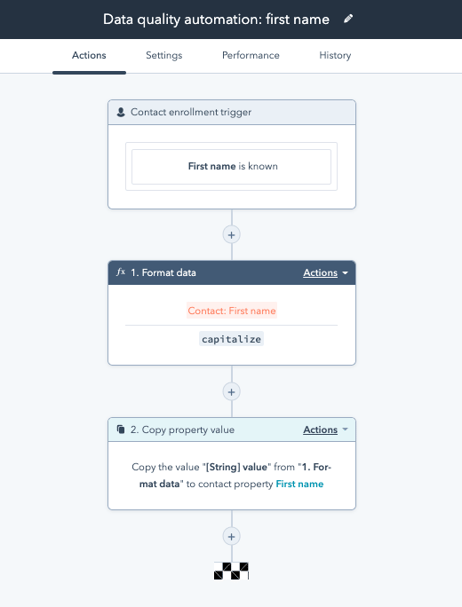
With HubSpot’s Operations Hub, there is an easy way to keep your data clean using workflows. Within your workflows, Operations Hub gives you the option to add the ‘Format Data’ action.
With this new action you can do things like change the capitalisation of text, reformat dates into any format, or even perform calculations on numeric values.
When you use Operations Hub, you can simply click the plus icon for a new action and then click ‘Format Data’ to automate your workflow and data cleansing.
Get started with your data quality
Not sure where to start cleaning up your data? Or not sure which tool suits your business? Feel free to book a meeting with me and I will be happy to talk you through the options.