5 reasons to use lead scoring
 Carel Schrier
It has never been more important to bring in qualitative leads. Lead generation is a key pillar within many organisations, followed by lead nurturing. One essential element is often forgotten here: lead scoring. The method for ranking leads objectively. Not started yet? We give you five reasons why lead scoring is valuable.

What is lead scoring?
Lead scoring is a method for determining which leads are most interesting for your organisation. Based on certain criteria, you create a score and determine which lead is warm enough to be picked up further.
A lead score uses explicit and implicit lead scoring. With explicit lead scoring, you look at characteristics such as company size, age and industry. With implicit lead scoring, you assign points to actions a lead takes. Think, for example, of visiting landing pages, interacting with campaigns and opening marketing emails. These points are assigned automatically, giving you real time insight into relevant and qualitative leads.
Reasons to start with lead scoring
1. Focus on the target audience
Lead scoring works with positive and negative points, which together form a score. The higher the score, the better a lead fits within the target audience. This forms a good basis for creating separate segments and using them for campaigns. By using both lead scoring and additional contact information, you create increasingly relevant content for the target audience.
2. Correct prioritisation of leads
The score of a lead is a good indicator of the stage they are in. With a high score, a lead will move to a purchase more easily than when the score is very low. It is therefore important to respond directly to a lead with a high score and give that lead priority.
3. Perfect timing
Besides the insights lead scoring provides, you can also use it for perfect timing. Once you have used lead scoring for a while, you increasingly understand what each score means, and this can trigger targeted automations. Once a certain score is reached, you know what needs to be deployed (automatically) to push that score further up. The timing is perfect, and this leads to better results.
4. The basis for lead nurturing
Lead nurturing is connecting leads to your company through valuable content. Here, it is important to know which content is actually valuable to a lead. With lead scoring, you know what stage a lead is in and what they need to move forward. This way, you align valuable content perfectly with a lead's needs.
5. More effective
Working with lead scoring allows a marketing and sales team to work far more effectively. Marketing campaigns are deployed more precisely, so the advertising budget is spent better. This in turn has a positive effect on ROAS (return on advertising spend). The sales team can objectively distinguish between leads and thereby focus on the right people. As a result, the same period will show an increase in, for example, meetings, demos, visits, quotes or signed contracts.
Putting lead scoring into practice?
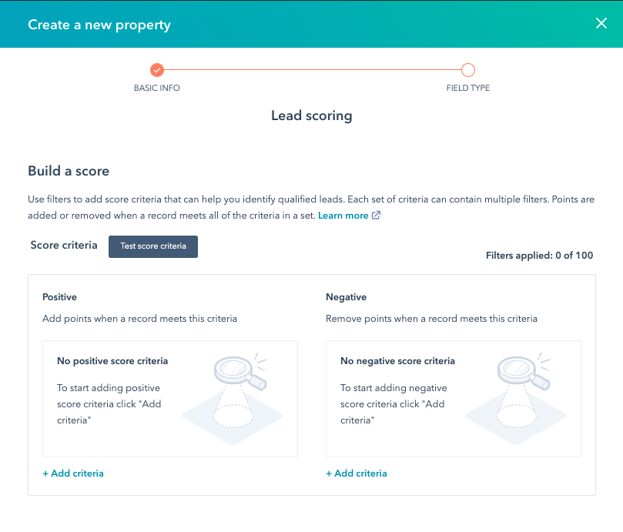
Lead scoring takes place based on the data within your CRM system. HubSpot is a CRM solution where you can set this up in full. A score is created using positive and negative points. These points are assigned based on pre-set criteria. Examples include:
- Company industry
- Company size
- Annual revenue
- Job title
- Campaign interaction
- Marketing email opened
- Website page viewed
- Meeting link used