The importance of a strong brand identity
 Carel Schrier
A strong image towards your customers is more important than ever. Consumers today have endless choice. As a company, it is therefore essential to make clear why the consumer should choose you instead of the competitor. What story do you tell? What makes you unique and what do you strive for? These are all matters related to your company’s brand identity. But how do you actually define a brand identity, and how do you then translate this into a good strategy? You can read all about it in this article.

The benefits of an effective brand strategy
To begin with, you naturally want to know what an effective brand strategy can deliver for your company. Firstly, a clear brand strategy ensures, provided it is approached properly, that you can reach new customers. A good brand strategy focuses all its expressions on the target audience you have in mind. This means you will also appeal to potential customers.
In addition, a good brand strategy helps you build loyalty and trust with your current customers. By conveying your relevant brand message to your existing customers, you create engagement and build a bond with them. This can ultimately work in your favour, for example when one of your customers recommends your brand to friends or family.
Finally, a strong brand strategy also benefits your own staff. A good brand strategy can create a strong sense of association with your brand among your employees. They then radiate this feeling towards your customers in turn. It is also important that your staff are all aligned on your brand identity, so that every expression consistently communicates the same, correct brand message.
Defining your brand identity
The basis for establishing your brand is defining your brand identity. It is important that you shape your brand identity from your company’s core values. These include, for example, your company’s mission and vision.
To map out your company’s mission, you can, for example, use Simon Sinek’s Golden Circle. Here you first look at the reason your company exists (why). Next, you look at the ‘how’, meaning how you realise that reason for existing. Finally, you look at the ‘what’ of your company (the products or services you offer).
Your company’s core values also play a major role in shaping your brand identity. It is important to think about your company’s corporate identity here. In other words, ‘who are you?’ and ‘who do you want to be?’.
Besides your core values, visual aspects also play a part in creating your brand identity, for example your logo or your company’s house style. It is important here that you link these factors to your core values, for instance by paying close attention to the colour use in your logo.
The next step: positioning
The next step in establishing your brand is positioning. You do this by mapping out your target audience and competitors. You can use the MDC model for this.
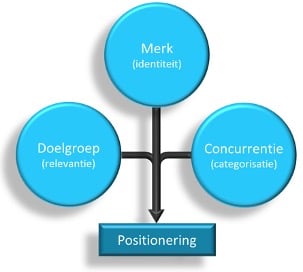
Based on the brand identity you defined in the previous step, you first look at which target audience you want to target. This can be done, among other things, by creating a buyer persona.
Next, you map out all your competitors. You can choose to categorise your competitors, for example by brand level, product level, generic need level and budget level. This gives you a clear picture of your competitors’ strengths and weaknesses and how you distinguish yourself from them.
Your entire brand strategy in one clear model
By working out the MDC model, you have the basis for your eventual brand essence. To arrive at this brand essence, the so-called Brand Key model can be used.
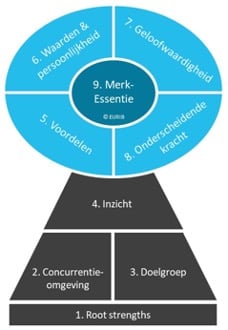
The first three steps of the Brand Key model consist of the same aspects as the MDC model. At step 4, you look from the target audience’s perspective at how they see your brand. You formulate this using the following sentence: ‘I would like…, because…, but…’.
This way, you map out not only the need but also the brand problem at the same time.
In addition, this step forms the bridge to the remaining 5 steps, which focus more on the internal side of the brand.
At step 5, you map out the benefits of your brand. This can be on both a functional and a psychosocial level. Functional benefits are tangible benefits of your product or service, while psychosocial benefits focus on the emotional side.
For the ‘values and personality’ step, you formulate the values the target audience associates with your brand. This can be shaped at multiple levels, for example in the form of instrumental values or terminal values.
At step 7, you identify the arguments the target audience might have for choosing your brand. As with step 4, this is shaped in a sentence from the target audience’s perspective. For example: ‘I choose…, because…’.
At the penultimate step, you make clear what the actual difference is compared to other brands. In other words, your unique selling points that set you apart from your competitors.
Once you have gone through all the preceding steps, you finally arrive at the brand essence. This is, in effect, a summary of steps five through eight and always consists of no more than three words. These words should make it immediately clear what your brand stands for.
How do I translate my brand message into practice?
Once you have worked out the Brand Key model, you have a clear picture of what you want to convey as a brand. You also know which target audience you want to reach with your brand message and what your unique selling points are compared to your competitors.
The next task is then to convey that brand message to your target audience in practice. To do this, it is important to first look at which channels your target audience is often active on.
To actually reach the target audience through those channels, relevant content needs to be created. This could be, for example, photos, videos, infographics or advertisements. Do make sure that your brand message always comes through in these expressions.
The goal of all these expressions is ultimately to evoke the intended associations with your target audience. This should ultimately ensure that when an emotion or need arises, they think of your brand and therefore end up with you in their search for a solution to that need.
In short, building your own brand identity can therefore be of essential value to your company’s growth for several reasons. It not only helps you appeal to new customers but also creates engagement and builds loyalty with your current customers.
So make sure you have a clear picture of the message you want to convey to your intended target audience, and ensure this message also comes through consistently in all your marketing campaigns and content that you distribute.
Need help mapping out your brand identity? Get in touch with us, we’re happy to discuss the possibilities together with you.