Hubspot state of Marketing 2024
 Carsten huiskamp
The state of marketing: Trends and tips
In the (online) marketing world, everything changes constantly. From new technologies to shifting customer preferences, it is essential to stay on top of the latest tools and strategies in the (online) marketing world. In this blog, we explain the latest trends in the (online) marketing world.

Scalable relationships and proving ROI
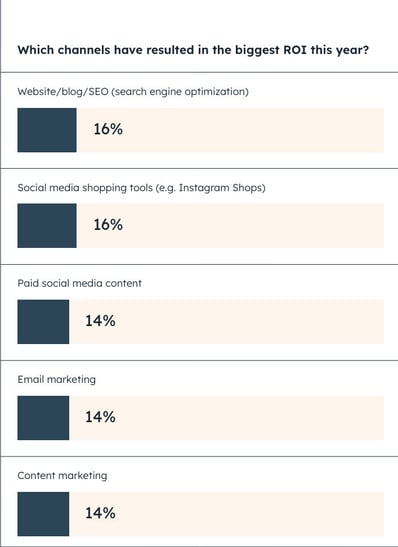
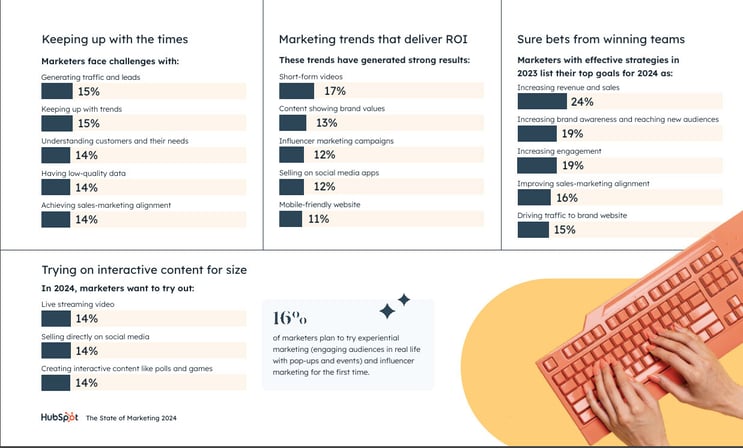
When you look at your marketing budget, you naturally want to know exactly what it delivers. This requires reliable reporting linked to your sales figures. It is essential that both your marketing team and your sales team have access to this information. For many companies, collaboration between sales and marketing teams still remains a major challenge. This collaboration is essential, as it leads to improved lead qualification, which ultimately increases the chance of successful conversions. This challenge is very important, other key challenges and opportunities include:
- Personalised experiences for more sales and loyalty.
- Innovative ways of working to build customer relationships.
Social media: The place for search, sales and service
Among Gen Z and Millennials, social media is the most important platform for sales. About 31% of consumers look for answers via social media. In addition, 17% of users buy products via social media. As a company, you should naturally make use of this. Social media is also crucial for service; in 2023, 19% of users sent a DM for customer service, an increase of 45% compared to 2022. One in five young consumers prefers customer service via DM.

Marketers, it is time to embrace bots
According to HubSpot research, 55% of companies expect most people to choose chatbots over search engines in 2024 and beyond. AI-driven chatbots offer a user-friendly, personalised approach. At the same time, these chatbots also collect data that can help grow your company. In 2023, 25% of marketers used AI and automation such as chatbots.
So start with a marketing bot on your website. Train your bot with your content so it can quickly answer questions about products and pricing. At HubSpot, the AI chatbot fully answered 78% of questions, which led to higher customer satisfaction.
Statistics:
- 36% of marketers use AI chatbots and 58% plan to increase their investments in 2024.
- 72% of marketers believe that AI and automation such as chatbots help personalise the customer experience.
- 24% of marketers think that AI tools for customer service (chatbots, self-service tools, AI emails) would help their company the most.
E-commerce comes into play too
87% of marketers want to continue or increase their investments in mobile messaging via SMS, Facebook, Messenger and WhatsApp. Currently, one in five marketers worldwide uses mobile messaging, 10% call it a key ROI driver, and 12% want to invest in mobile for the first time in the new year. France and Singapore are leading the way here.
Vinomofo, a large Australian online wine retailer, wanted to maintain personal contact while growing. With HubSpot and MessageMedia, they automated personalised SMS communication, which led to better sales conversions and streamlined workflows.
"The more we personalise, the better the results. By integrating HubSpot with MessageMedia’s SMS platform, we can offer a consistent omnichannel customer experience."
Video grabs attention and delivers ROI
Video continues to deliver the highest return on investment (ROI), which is why more and more marketers are diving in. TikTok, YouTube and Instagram are favourites for reaching younger audiences who prefer social video platforms over search engines. Short videos offer the highest ROI and will grow the most in the new year. A quarter of marketers will invest more in short videos, and more than half will increase their investment.
Aja Frost from HubSpot advises: "Use social listening tools to understand which questions prospects and customers ask, and create content that answers these questions."
Build your video strategy:
- Optimise your YouTube videos with keywords and create playlists of popular content.
- Experiment with AI video tools such as Pictory and Synthesia to turn blog posts into videos.
Privacy is essential for personalisation!
In a future without cookies, first-party data is the only way to personalise content. The way marketers collect data is changing rapidly. Google is stopping third-party cookies due to privacy concerns, meaning companies now need to collect their own user data. This is not only safer but also necessary, since only 65% of marketers currently have high-quality data about their target audience.
Email is ideal for collecting first-party customer data, since customers fill in the data via email and forms themselves. By letting customers indicate how they want to be approached, you can gain valuable insights without depending on third-party data. Although 87% of marketing leaders say email is crucial, only 24% is well integrated with other channels. Now is the time to use email as a source of insights.
How to incorporate first-party data into your email strategy:
- Review what data you have and what you still need.
- Determine which data points take priority.
- Collect data subtly (it should not feel like an interrogation.)
- Set data priorities based on your current database.
This way, you can personalise effectively while respecting privacy, and improve your marketing strategy!
More big ideas? Let AI help you!
Want more time for big ideas? Let AI take over manual, recurring tasks. With smooth-running systems and AI support, anything is possible. AI is more efficient and more effective. If you automate your recurring tasks, you can work much more efficiently because you simply have more time left over. 64% of marketers already use AI and automation. 38% of those who do not yet use it plan to start in the new year.
AI is seen as an assistant that helps with work. 20% of marketers see AI as help for simple tasks and 60% see AI as an assistant. 81% of marketers who use Generative AI (GAI) say it is effective. Moreover, 63% of marketers believe that in 2024 most content will be partly created with the help of GAI. So far, 56% say that GAI-created content performs better than content without AI. AI is the future, so as a company you will need to respond to this.
Navigating the new marketing landscape with first-party data and AI
The B2B marketing world is changing rapidly, and marketers need to effectively reach and engage their target audience. With the disappearance of third-party cookies, marketers are shifting towards collecting first-party data and using AI to create personalised content. This application of AI increases the quality and effectiveness of content. As many as 63% predict that most content in the new year will be supported by AI.
The power of generative AI
Generative AI is not only about efficiency, but also about high-quality content. This technology enables marketers to create personalised and relevant content that better matches the needs and interests of their target audience. This allows companies to improve their customer engagement and conversion rates.
Platforms such as WriterAccess show how AI and human creativity can work together. AI creates the initial content, while human writers refine it and check it for facts and brand voice.
Overcoming obstacles in AI adoption
Integrating AI into daily workflows is challenging. Although half of marketers use AI for specific tasks, 46% feel overwhelmed by the idea of AI integration. In addition, six out of ten marketers who use AI are concerned about bias and deviation from brand values. This shows how important it is to integrate AI carefully and preserve your brand values.
Adapting to changes in data privacy
With rapidly changing rules around data privacy, marketers know this affects their strategies. 84% see the impact, especially due to Google's gradual phase-out of third-party cookies. As a result, many marketers are looking for alternatives such as social media targeting and collecting first-party data. Innovative content, such as interactive content from Rock Content's Ion, provides valuable first-party data and is a good alternative in a world without cookies.
Personalisation for a better customer experience
Despite data privacy challenges, marketers need to understand their target audience better. Only 35% of marketers indicate that customers receive a strongly personalised experience. Still, the benefits of personalisation are clear: 96% say it increases the likelihood of repeat purchases and 94% claim it boosts sales. So you will still need to find an alternative way to deliver a personalised experience.
The future of marketing: Human creativity and AI
The future of B2B marketing lies in the combination of human creativity and AI. Marketers who embrace this shift will achieve unprecedented customer engagement and satisfaction. This progress towards more personalised, efficient and impactful marketing will change the way companies connect with their target audience. It is therefore crucial to stay up to date in this online world.
Marketing alignment starts with centralised data
Only 35% of marketers say their sales and marketing teams are well aligned. This is often because they do not have a shared data source. The main challenges in sales and marketing alignment are:
- Lack of effective communication
- Different tools
- Difficulty with data sharing
The consequences of poor alignment are: - Wasted marketing budgets
- Lost sales opportunities and disinterested leads
- Impersonal customer experience
Marketers with a single data source are 56% more likely to be well aligned with their sales team and 26% more likely to have an effective marketing strategy. In 2023, CRM became more important, and teams with CRMs are 128% more likely to succeed. AI and automation help with this; three out of four marketers say it improves data sharing and collaboration.
With the right tools and data, sales and marketing teams can collaborate better, leading to better results and a better customer experience.
Key takeaways and action items
-
Efficient systems give marketers more time to be creative: marketing operations teams are crucial. Give them the resources and time to work more efficiently and create more room for creativity.
-
Use AI to automate manual tasks and improve your targeting: let AI take over recurring tasks and improve your targeting for more focused campaigns.
-
Try AI to better understand your target audience and scale a personalised approach: use AI to gain in-depth insights into your target audience and scale personalised marketing campaigns.
-
AI is only as effective as the people who use it, invest in training and clear guidelines: provide good training and clear guidelines for your team to use AI effectively.
-
Share tips with your colleagues to get the most out of AI tools: share knowledge and best practices within the team to make optimal use of AI
-
With AI you can work more efficiently, understand your customers better and have more time for creativity and growth: AI makes your work more efficient and helps you understand customers better, leading to more creativity and growth.
Conclusion
By embracing AI, aligning your teams and centralising your data, you can take your marketing strategy to the next level and build a stronger bond with your customers. The future of marketing is about efficiency, personalisation and collaboration, all supported by the right technologies and data insights. Prepare for success by following these trends and strategies!