What is the difference between HubSpot and Salesforce?
 Carel Schrier
There are many CRM platforms on the market, each offering different solutions. The CRM platforms that are consistently rated as the best are HubSpot and Salesforce. Not without reason, as both platforms contribute to the success of many organisations. Reason enough to go through and explain all the differences between these two platforms.

HubSpot versus Salesforce
Both HubSpot and Salesforce are cloud-based CRMs that use various tools to help teams collaborate and drive growth. Both platforms work from a centralised data management system and connect various hubs and applications to it. These hubs and applications are aimed at specific marketing, sales and service tasks. This makes it possible to work more efficiently and effectively, with all of it reflected in clear reporting. In addition, automation is hugely important on both platforms for bringing in new leads and scaling activities.
At first glance, the two CRM platforms do not appear to differ much from each other. However, the way the platforms are built does differ. Salesforce has an extensive product portfolio thanks to the many acquisitions it has made. With more than 60 acquisitions, this makes it a so-called cobbled CRM. This immediately makes the CRM quite a bit more complex. HubSpot is built from a single foundation. All five hubs are seamlessly connected to one another.
There are also quite a few other differences when we look at the functionality, ease of use, scalability and price.
Comparing HubSpot and Salesforce tools
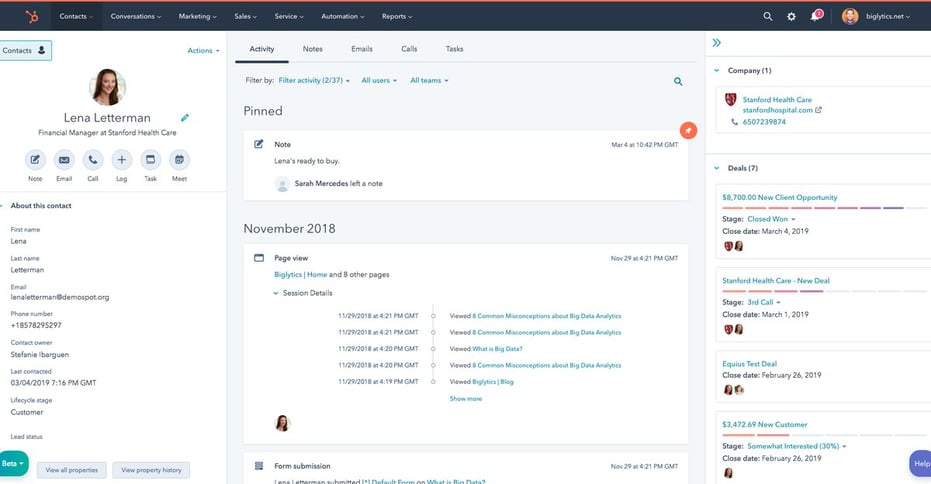
Both HubSpot and Salesforce are set up to store customer data. However, HubSpot's CRM is geared towards contacts, with the focus on marketing. Salesforce, on the other hand, is more geared towards accounts, where account management is more important. There is also a big difference in the interface. Where Salesforce uses a traditional interface, HubSpot looks much more attractive.
HubSpot interface:
Salesforce interface:
.png?width=975&name=blog-salesforce-ui-new-ui-1%20(1).png)
HubSpot started out as a marketing tool and is well ahead of Salesforce in the marketing space. There are an enormous number of options when it comes to lead generation, lead nurturing and automations. Salesforce is built more as a sales tool and is ahead of HubSpot in that respect. The main difference here lies particularly in customisation. When complex sales processes are in use, Salesforce can offer more options. Within HubSpot, you can use the ticketing system and knowledge base, and measure customer feedback. Salesforce places less focus on this.
Ease of use of HubSpot and Salesforce
Besides the interface, HubSpot is also the winner when it comes to ease of use. The platform, with its various hubs, is designed for marketing, sales and service teams. It is not complicated, and new users can get started with it quickly. Salesforce is somewhat more complex, and it is necessary to make an internal administrator responsible for it. Implementation is a bit more complicated, and dependency on an external agency is high.
Customer support is also structured differently across the two platforms. HubSpot pays a lot of attention to customer support. It offers 24/7 support via chat, phone and email for customers with a Professional or Enterprise subscription. It also offers inspiring courses that let you take your (HubSpot) knowledge to a higher level. The HubSpot Academy can be used free of charge.
Salesforce also offers 24/7 support, but this comes with additional costs. These costs are also based on the contract price, so the more growth you achieve, the higher the price of customer support becomes. Salesforce also offers the option of taking free training courses through their Trailhead Academy. Unfortunately, taking the training courses alone is not enough to achieve real success.
5 advantages of switching from Salesforce to HubSpot
1. All-in-one system: teams within an organisation work in the same system every day. This leads to better collaboration and a better experience for employees themselves.
2. CRM adoption: ease of use and scalability make it much easier, and automatically more enjoyable, for employees to work with HubSpot. Keeping track of data is straightforward, and productivity is higher thanks to the use of sequences and meetings, among other things.
3. Business insights: because the entire organisation works within one system, there is better insight into the business. This makes it possible to make business decisions based on data.
4. Fast action: changes within the system can be handled internally. A Salesforce developer is no longer necessary. This brings a huge amount of speed, because making a change is arranged quickly and does not take months.
5. Customer experience: all customer data sits in one system, giving a comprehensive picture of characteristics, activities and needs. These insights lead to better service, with the ultimate goal of an outstanding customer experience.
Prices
When exploring and choosing between different CRM systems, price plays an important role. Keep in mind that implementing a CRM system involves not only system costs but also consultancy costs. These costs are considerably higher with Salesforce than with HubSpot.
For a team of 50 people using the sales software, you can expect the following total costs, which makes the difference in price clear:
HubSpot sales hub Enterprise: 75,000 dollars.
Salesforce sales cloud Enterprise: 236,000 dollars.
(source)