HubSpot versus Pardot
 Carel Schrier
Choosing the right marketing automation software is essential for your business. It forms the foundation on which your teams will collaborate using the same data. In this blog, we compare HubSpot and Pardot, so you can make the right choice for your business.
 What exactly are these tools?
HubSpot Marketing Hub is a marketing automation software that enables users to combine and strengthen marketing with CRM data. Because the software is integrated with your CRM data, you have everything you need to apply automations within your Inbound marketing campaigns to grow your business. Capture the attention of your prospects, get more leads and report from one central place.
Salesforce Pardot is a cloud-based CRM platform with applications for sales, service, marketing and more, designed to bring your customers and business closer together. Pardot is a marketing automation solution that was developed as a ‘stand-alone’ platform in 2007 and was later acquired by Salesforce.
All-in-one solution
Marketing automation, CRM, Sales and Service Hubs are all logically built by HubSpot. The result is that the platform offers a uniform and consistent user experience. Customer data, reports and individual tools work in the same way and function in harmony with one another. HubSpot is intuitive to use across the entire platform, even for advanced applications. This results in an easier learning curve for your employees, so your business develops faster.
As mentioned, Pardot was acquired by Salesforce to expand its product portfolio. The Salesforce platform has grown mainly through acquisitions of external solutions, such as Pardot. As a result, a connection between the platforms must be established manually to offer a uniform user experience, along with the necessary technical complexity.
What can these two heavyweights actually do?
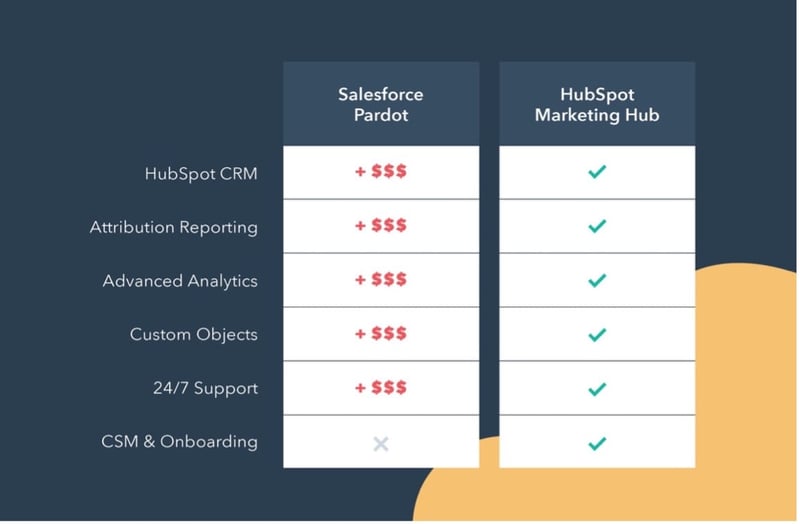
HubSpot Marketing Hub has an integrated set of tools focused on lead nurturing. Lead nurturing means building a valuable relationship with your prospects in order to eventually convert them into a customer. The set of tools includes: website hosting, ads, landing pages, blogging, email marketing, account based marketing, social media, workflows, automations and attribution reports. All these tools are easy and straightforward to use, and work seamlessly together.
Pardot can also be used for lead generation with a toolset that has become a ‘standard’ within the marketing world, such as landing pages, email marketing, workflows and the like. However, Pardot is still entirely focused on email automation, so as a user you need to connect more tools to Pardot as you scale up.
Consider the fact that landing pages usually sit on a subdomain or a separate ‘third party’ domain. Measuring across the different domains is possible, but fairly cumbersome. In an era where usability and customer experience are central for both the marketer and the customer, this is not ideal. It is also not ideal for the SEO, or findability, of your website compared to content that lives on one and the same domain.
Marketing driven by CRM data
HubSpot's Marketing Hub is a marketing automation platform that offers high-quality marketing automation tools within a world-class CRM. This unique combination is the only genuine way to deliver CRM-driven marketing.
With Marketing Hub, you attract the right customers, grow your contacts faster and ensure unique, personalised messages are delivered through the right channel. This helps you capture your customers' attention and surprise them with a smooth customer experience.
Pardot, on the other hand, has no Inbound CRM system. For that, you need to purchase Salesforce or another alternative via an integration. This combination is cumbersome and not seamlessly connected.
Complete attribution reporting
Make sure your marketing team gets the credit it deserves. How do you do that? HubSpot helps you gain insight, through revenue and contact attribution reports, into how much influence your different teams have had at every step in the sales process, from generating interest to closing deals. Attribution reporting makes it easier to make data-driven decisions when you need to make choices for your budget. You can simply identify which channels perform best and which channels might need some adjustment.
When it comes to these reports and analytics, Pardot cannot compete with HubSpot. Salesforce does offer the necessary paid add-ons, so you can add these functionalities. Even with these paid additions, you still need to ensure internally that these reports remain operational and are maintained.
Unmatched support
When you compare Salesforce and HubSpot, they really have a completely different philosophy when it comes to customer service and customer contact.
HubSpot has focused on its customers' success from day one. HubSpot's support lines are available to all its customers via phone, email and chat. Professional and Enterprise users do not have to pay extra for this support, and even as your business grows, there will be no additional costs involved. HubSpot also has one of the best online learning platforms in the form of the HubSpot Academy. This Academy is available to every HubSpot customer.
Pardot charges 20% of your net contract for 24/7 premier support. Extra access to features costs 30% of your net contract value. With these costs calculated as percentages of your contract, your support will become more expensive as you add extra users to your contract or need add-ons. So you pay more for the same support. If you choose Pardot, you will therefore need to thoroughly research in advance what your team will need in the future.
Scalability and customisation within HubSpot and Pardot
HubSpot and Pardot have both built powerful software for fast-growing businesses. As your business grows, it is important that both your CRM and marketing automation software have the flexibility to grow with you. As your business grows, its needs will change too. With this in mind, it is crucial that you actually have the flexibility and control to make adjustments within your CRM and marketing automation.
At HubSpot, priority is given to ease of use and automatic recommendations, making it easy for businesses to get started. HubSpot's usability means you are in control of the system's flexibility. As your business grows, you can adapt the system as you wish. This results in a system that seamlessly aligns with your business's changing needs.
Pardot offers endless customisation for the most complex organisations. As a result, advanced capabilities may require more support from developers and administrators. This affects flexibility and leaves businesses facing difficult choices when making changes within their Pardot environment.
Usability
As mentioned, ease of use within HubSpot is a priority for the company, making it easy to use for administrators, managers and representatives alike. This way, you spend less time (and money) on working the way you envision. HubSpot customers have the freedom to set up and maintain the tools in their own way, so they align with the business.
The implementation and maintenance of Salesforce Pardot requires experienced administrators. Most Salesforce customers have purchased consultancy hours or have had to open a vacancy for full-time administrators of the system. It may also mean that current employees have to take on extra tasks to make the system workable.
Switching from Pardot to HubSpot
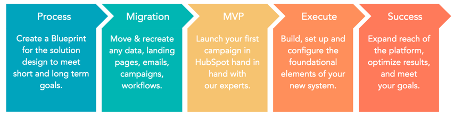
Are you currently using Pardot and want to switch to HubSpot? No problem. Our team has experience migrating from Salesforce to HubSpot and will ensure a migration with minimal disruption to your business. During the migration, we look at the most efficient and best solution. We certainly do not simply copy and paste, but look directly at setting up optimal processes. This means your system is immediately ready for the years ahead, so you can continue to scale your business.
HubSpot and Salesforce integration
Are you currently happy with the software you get from Salesforce, but looking for additional software for marketing, sales and/or service? Then it is also possible to get this from HubSpot. There is a fast, reliable and powerful integration available between Salesforce and HubSpot. Data synchronisation is set up within minutes, with no technical hassle involved. This makes it possible to use both platforms for the different teams within your business.
What is the difference in cost?
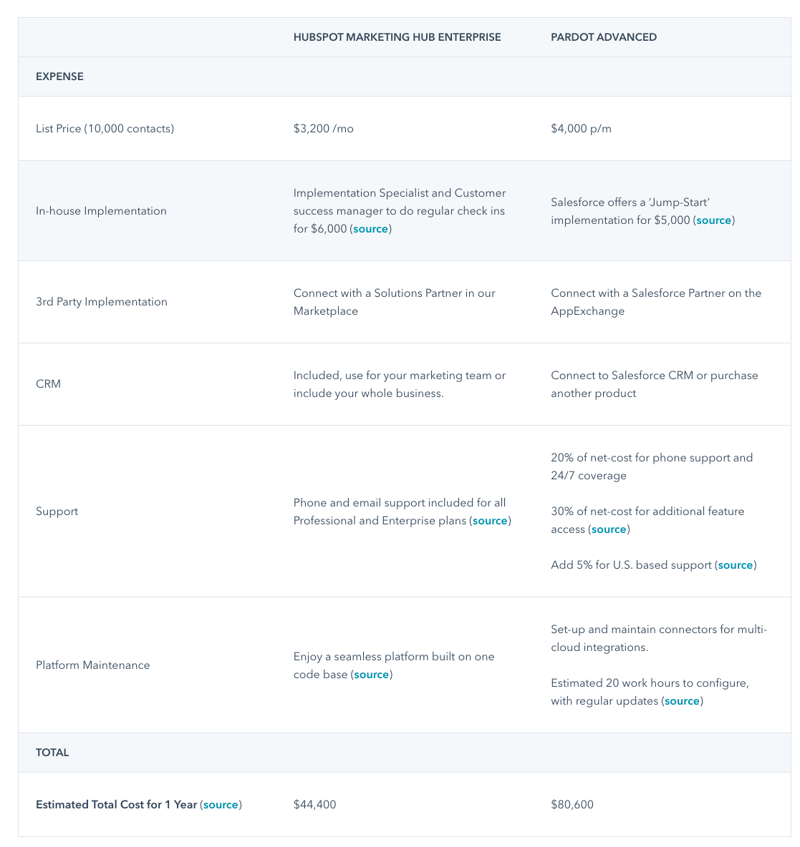
Because both tools have many options, comparing prices is somewhat more complicated, but we've made it clear in a handy overview. In this overview, we put the standard subscription costs side by side, along with what you ultimately end up paying for the tools.
Grow your business!
Use HubSpot to streamline your marketing and bring your team, tools and data together in one central place. Want to know more about this solution? Then schedule an appointment with Carel.

Want to know how HubSpot can help you?