The Relationship Between Customer Experience and Marketing
 Carel Schrier
Every year, various marketing terms come around that companies want to invest more in over the coming year. Often these are things like social media, video marketing, mobile-first, or other topics that will sound familiar to you.
However, recent years have also shown, in among others a report from Annual Digital Trends, that increasing focus is being placed on optimising the customer experience.
There is a close relationship between marketing and customer experience when it comes to defining, communicating and managing the customer experience.
In this blog we take a closer look at the connection between these two. Where do marketing and customer experience meet, who "owns" the customer experience, and we show best practices for marketing to support the customer experience.

What is customer experience?
It might be good to start at the beginning: what actually is customer experience? Customer experience refers to how a customer thinks about every interaction they have with a company across all touchpoints. Since the marketing team is usually responsible for creating buyer personas, collecting data and contact with prospects, it is crucial that marketing works together with sales and service to ensure the whole organisation delivers an exceptional customer experience.
Delivering experiences that make customers happy requires a planned, proactive and holistic strategy that covers the customer journey and the lifecycle. A study by Walker into customer experiences identified personalisation, ease and speed as crucial elements of a positive customer experience.
Customer experience does not stop after the sale. In fact, some of the most powerful opportunities to build loyalty, drive repeat purchases and generate referrals are experiences with service and support after the sale has closed. HubSpot's flywheel model offers a modern view of how companies can evolve by putting the customer experience at the centre of the organisation's focus.
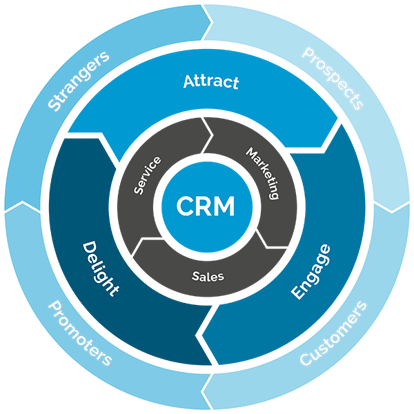
The "delight" phase drives the "attract" phase of the inbound methodology, because customers naturally talk to others about their experiences. Word of mouth is one of the most powerful ways to attract new customers.
Delivering an exceptional customer experience is a continuous effort. This makes it essential that your sales and service teams work together to ensure you stay on top of an ideal customer experience.
Who "owns" customer experience?
Has your company defined who "owns" the customer experience? Is it sales? Marketing? Or perhaps service? A 2018 study by PWC on Customer Experience made it clear: responsibility for delivering an excellent customer experience (CX) lies with the entire organisation.
Moreover, in a recent Digital IQ report by PWC on effective digital strategies, 65% of respondents consider customer experience crucial to improving business performance.
The rise of digital marketing gives marketers the tools to communicate with buyers on an individual level, across channels and touchpoints at every stage of the lifecycle. So where is the unique role for marketing in managing customer experiences?
Although the entire organisation is responsible for delivering experiences, marketing is often best positioned to listen to, analyse and advocate for the needs of the customer.
By delivering reliable, fact-based insights into the customer experience, marketing helps break down departmental silos. Continuing to work in silos is a major obstacle to a consistent CX approach.
Let's look at four best practices for marketing to support your organisation's customer experience strategy.
1. Listen to customers at scale and share the insights
Conversation data
Marketing that has a meaningful impact on the customer's experience requires effective analysis and interpretation of conversation data. Data is used not only to target marketing campaigns, but also to improve the customer experience.
Segmentation
Digital marketing automation platforms make it easy to track data and act on it. Data such as customer history, behaviour and interests make it possible to develop segments to better target customers, and also provide insight into how you can offer a better experience.
KPIs
Key performance indicators such as conversion rate, drop-off rate, retention rate and satisfaction scores need to be identified, monitored and tracked in a way that is clearly visible to all teams within your organisation. These shared insights drive change and reinforce progress. It also contributes to a culture where everyone is responsible for delivering an exceptional experience.
2. Know the voice of the customer
Direct feedback from customers is essential for understanding and improving experiences. Traditional research methods such as satisfaction surveys, focus groups and interviews continue to play an important role in assessing satisfaction and capturing the voice of the customer.
However, digital technologies offer new ways to supplement this information. Tools such as social listening, live chat and website analytics provide opportunities to track customer feedback in real time. In addition, sales and service teams can capture customer feedback through observation, field reports, complaints or other means.
Regardless of the method, it is important to maintain a customer journey or experience map. This way you gather feedback on the holistic experience rather than remaining within silos.
3. Collaborate to drive change
Unfortunately, it is often the case that marketing teams take responsibility for attracting prospects and generating leads, but are then barely involved once qualified leads have been handed over to sales. This often leads to a disjointed customer experience.
Instead, marketing teams can share the results of "listening" to your customers, so you can work together in a more customer-centric way across your processes. When marketing gathers insights about customers, this knowledge gives your teams a shared goal to work together on changes that improve the customer experience.
Put simply, marketing teams can support the customer experience by creating meaningful and valuable content for the buyer's journey. From there, you can identify and develop valuable buyer segments and personas to adjust your targeting.
Moreover, these insights can have a much broader impact when shared and used to identify bottlenecks, solve problems and make processes more customer-centric. It could even be possible for marketing teams to organise workshops or brainstorming sessions with all departments to generate solutions and build more support for these customer-centric changes.
Naturally, it is difficult for marketing to bring about change without support from the management team. One way marketers can achieve this is by calculating the ROI that improvements in customer experience deliver. Satisfaction and Net Promoter Score (NPS) are two popular KPIs. Other popular KPIs include, for example, drop-off rate, conversion rates or the average time to resolve a service issue.
4. Invest in automation
To successfully create an ideal customer experience, you should consider acquiring software to apply automation within marketing and sales. Below we give a few examples of what automation can contribute within marketing and sales:
Marketing automation focuses on increasing traffic and raising conversion rates. Tools provide insight into customer needs by tracking their website usage, downloads or other data. Automation tools can improve the customer experience by sending personalised and targeted messages tailored to the customer lifecycle.
Sales automation provides insight into prospects with tools such as sales process sequences, quote workflows and updates on your representatives' performance.
For marketers, marketing automation facilitates an improved customer experience by providing customers with the right information at the right time.
Research has shown that responding to a lead within five minutes greatly increases the chances of making contact. However, it turns out that more than half of current companies do not respond within five days. By applying automation, you can drastically shorten this turnaround time. Marketing automation not only improves the overall customer experience, but is also crucial for generating leads.
To create an exceptional customer experience, you ultimately need collaboration from all three departments within your organisation: marketing, sales and service. As a marketer, you may need to take the lead on this. You can share important data or gathered information with sales and service teams while also remaining open to feedback from these teams.
Curious how we can help you improve your customer experience? Feel free to contact us!